
Software In The Age Of AI
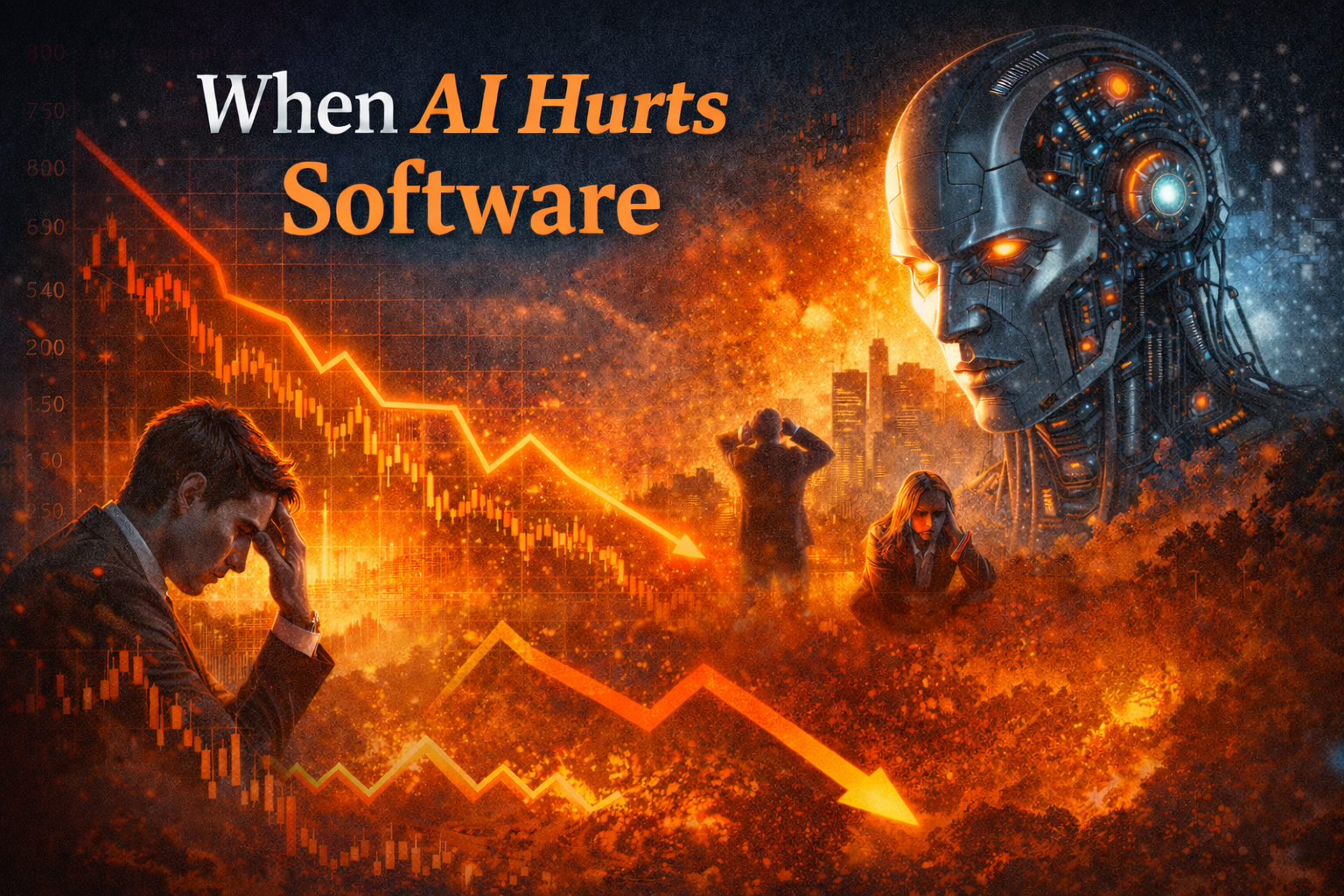
Artificial intelligence is often described as the next great engine of software growth. It writes code, answers questions, automates support, summarizes documents, and reduces friction across digital work. For years, that promise made AI sound like an upgrade for the software industry. But a different reality is now coming into view: in some parts of the sector, AI is no longer just enhancing software companies. It is beginning to hurt them.
The damage does not look the same everywhere. In some companies, AI is reducing traffic. In others, it is weakening pricing power, shrinking the need for certain teams, or making investors question whether older software models still deserve premium valuations. The disruption is not always dramatic at first. Sometimes it begins quietly, with fewer clicks, lower engagement, slower growth, or a restructuring memo that says the company must “reallocate resources” toward AI.
Chegg is one of the clearest examples. Its management explicitly linked falling traffic and revenue to the rise of AI answers and Google’s AI Overviews. By full-year 2025, Chegg’s revenue had fallen 39% year over year, and earlier in 2025 it said its non-subscriber traffic had plunged 49% in January. That matters because Chegg’s old advantage depended on people coming to its platform to find answers. Once the answer appears directly inside an AI interface or search result, the visit itself becomes unnecessary. The software did not just face more competition. Its route to the customer was weakened.
Stack Overflow shows a subtler version of the same problem. The company has openly said that AI’s ability to provide direct answers is reducing traditional web traffic. Yet the irony is that developers still need human-verified knowledge, especially when AI gets things almost right but not fully right. Stack Overflow’s own survey data shows that many developers now visit because of AI-related issues, while trust in AI tools is slipping. That creates a strange new position: AI is taking away the easy traffic, while leaving behind the harder questions. The platform becomes more necessary in one sense, but less naturally discoverable in another.
Then there is the internal pressure inside software companies themselves. Atlassian’s March 2026 restructuring is a good example. The company said it was reorganizing to self-fund faster investment in AI and enterprise sales, while Reuters reported that about 1,600 jobs were being cut. This is an important shift. Even when AI does not destroy demand for a company’s product, it can still force a downturn in parts of the company’s structure. Teams, roles, and budgets that made sense in the pre-AI software model suddenly begin to look too expensive or too slow.
Investors are reacting to this uncertainty as well. In February 2026, Reuters reported that U.S. software and data-services stocks had been hit by a broad selloff tied to fears that AI tools could upend the sector, erasing about $1 trillion in value from the S&P 500 software and services index in a week. Adobe’s shares also came under pressure amid concern about generative-AI competition, while other names such as UiPath were judged against a harsher question: in an AI-heavy market, is this software company becoming more essential, or more replaceable?
What is happening here is bigger than a few bad quarters. AI is changing the shape of software value. If a product mainly organizes information, generates standard outputs, or sits between the user and an answer, AI may compress that value very quickly. If a company depends heavily on search traffic, repeatable knowledge work, or premium pricing for features that AI can imitate, the pressure becomes even more severe. The software industry is discovering that not every digital advantage is defensible once intelligence becomes cheap, fast, and embedded everywhere.
AI will not destroy software as an industry, but it is forcing a harsher selection process. The companies most likely to endure are those with trusted data, complex workflows, and high-consequence use cases. ServiceNow, for example, is protected by how deeply it sits inside enterprise operations. Intuit is protected by financial data, compliance-heavy workflows, and trust in moments where mistakes are costly. Oracle and Salesforce are making a similar case: when software is embedded in mission-critical systems and tied to proprietary data, it is harder for AI to commoditize. What becomes vulnerable are the companies built on lighter convenience, searchable answers, and easily replicated outputs. In that world, AI is not just another feature. It is a force that changes what software is worth.
The old fear was that AI would replace workers. A deeper fear is now emerging: AI may also replace parts of the software industry that once looked secure. And the companies most at risk may not be the weakest companies, but the ones whose value was easiest to imitate once the answer became more important than the application.

Leave a Reply
You must be logged in to post a comment.