
On That which Concerns Everyone
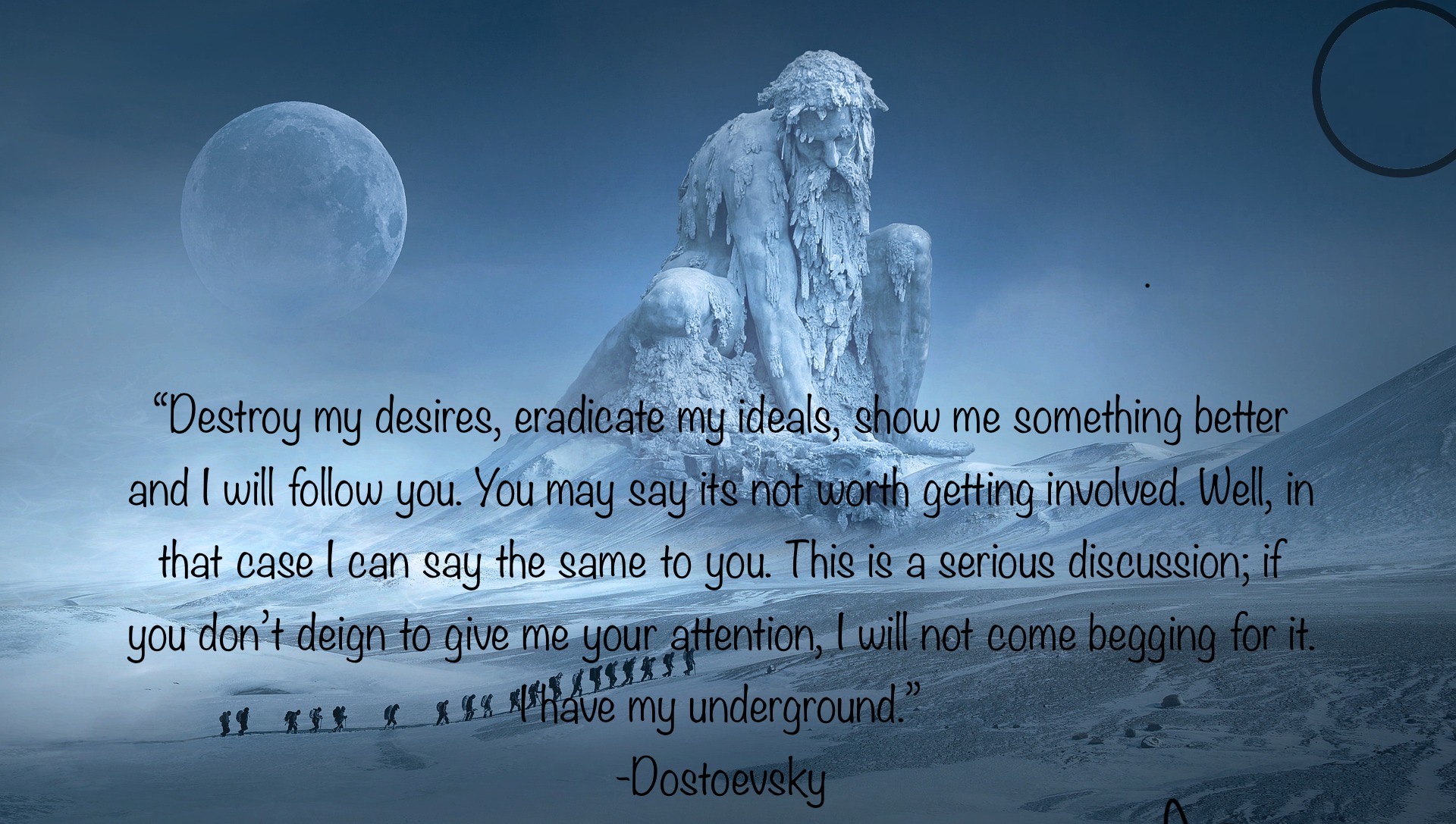
Just finished reading Dostoevsky’s Notes from Underground for the second time. It’s astonishing—and it reveals a dark reality about all of us and much of human history. Using the Underground Man as an anti-hero, Dostoevsky explores desire, human nature, and rationality as a critique of radical ideology.
On the power to make our own decisions
“All man needs is independent volition, whatever that independent volition might cost and whatever it might lead.”
“The reason why we sometimes desire pure nonsense is that in our stupidity we see in that nonsense the easiest route to achieving some kind of previously assumed advantage… Faced with the crystal palace of reason, man will deliberately desire the absurd, simply to prove that his will cannot be predicted.”
Human beings do not always do what is best for their own interests. Sometimes we risk comfort, success, and even dignity just to assert our right to choose. We choose nonsense not because we misunderstand advantage, but because we resent being reduced to advantage. If reason promises a perfectly engineered life, rebellion becomes a way of preserving authorship over it.
On consciousness as a disease
“I assure you, gentlemen, that to be excessively conscious is a disease, a real, full-blown disease. The normal man is spontaneous, active, and untroubled by endless reflection. It is precisely this spontaneous man whom I consider the real, normal person.”
“For the spontaneous man, twice two makes four and that is the end of it. But the excessively conscious man will insist that twice two makes five, not because he believes it, but because he wishes to assert himself against the tyranny of logic.”
Dostoevsky suggests that too much awareness can become paralysis. Overthinking fractures action; reflection turns into self-doubt; intelligence becomes self-sabotage. The spontaneous person accepts reality and moves forward. The overly conscious person feels trapped by what is obvious and resents the finality of facts. Denying the obvious becomes a strange proof of freedom.
On the reality of human nature
“I have a friend… he explains clearly how he must act in accordance with reason and truth. He passionately defends the true interests of man. And within a quarter of an hour, without any external cause, he acts in direct opposition to everything he has just said.”
“It seems there must exist something dearer to almost every man than his greatest advantages—something more advantageous than all other advantages—for the sake of which he is ready to act in opposition to reason, honour, peace, and prosperity.”
This is not simple hypocrisy; it is a divided nature. We are capable of understanding what is right, beneficial, and rational—yet something inside us resists compliance. Pride, resentment, boredom, or the desire not to be “managed” can overpower our own interests. We sabotage ourselves not because we are ignorant, but because obedience—even to truth—can feel like surrender.
On the world and civilization
“In short, anything can be said of world history… There is only one thing that you can’t say—that it had anything to do with reason. Civilization develops the many-sidedness of sensation, and through that development man may even find pleasure in bloodshed.”
Civilization does not eliminate chaos; it refines it. It deepens imagination, multiplies desire, and expands the range of what humans can feel—including cruelty. History is not a smooth arc of rational improvement. It is driven by passion, pride, insecurity, ambition, and fear. Reason often arrives afterward, explaining what impulse already decided.
On reason and the ingratitude of man
“Shower upon him every earthly blessing, drown him in a sea of happiness… give him prosperity so that he has nothing left to desire. And even then, out of sheer ingratitude, man would play you some nasty trick. He would deliberately desire the most fatal rubbish, simply to introduce his fantastic element and prove he is not a piano key.”
“Even if it were proved to him by science and mathematics that he is nothing but a key in a grand mechanism, he would purposely do something perverse—simply to gain his point and convince himself that he is still a man.”
Dostoevsky’s claim is ruthless: people do not want only happiness—they want volition. If a system offers comfort but threatens to make them predictable, they will destroy the comfort just to restore unpredictability. Freedom, even irrational freedom, can feel more essential than prosperity.
On love of suffering
“And why are you so firmly convinced that only what is conducive to welfare is advantageous? Does not man, perhaps, love something besides well-being? Perhaps he is just as fond of suffering. Man is sometimes extraordinarily, passionately, in love with suffering—and that is a fact.”
Human beings are creative animals, consciously striving toward goals. Yet we are also drawn to self-destruction and chaos. Suffering can become proof of depth, intensity, and individuality. It sharpens consciousness. And once suffering becomes part of identity, we may protect it—even while claiming we want relief.
On the process and the end
“Man is a frivolous and incongruous creature, and perhaps, like a chess player, loves the process of the game, not the end of it. Perhaps the only goal toward which mankind strives lies in the incessant process of attaining—in life itself—and not in the thing attained. For such positiveness as twice two makes four is not life, gentlemen, but the beginning of death.”
Dostoevsky suggests that the final answer feels lifeless. Arrival feels static. Striving preserves possibility; certainty closes it. The Underground Man resents “twice two makes four” not because it is false, but because it feels finished. And a finished life, perfectly explained and perfectly optimized, begins to resemble death more than freedom.

Leave a Reply
You must be logged in to post a comment.